How Solar Panels Work (Photovoltaic Effect)
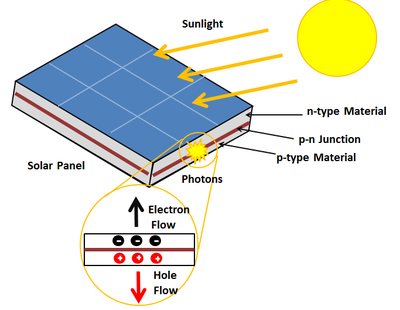


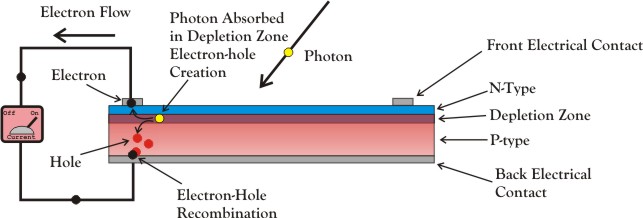
Solar panels are one of the most important technologies driving the global shift toward renewable energy. At the heart of every solar panel is a scientific principle known as the photovoltaic effect—the process by which sunlight is converted directly into electricity. Understanding how solar panels work requires exploring the structure of a solar cell, the properties of semiconductors, and the movement of electrons when exposed to light. This article explains the photovoltaic effect in detail and describes how solar panels transform sunlight into usable electrical power.
The Basics of Solar Energy
The Sun continuously emits an enormous amount of energy in the form of light and heat. This energy travels to Earth as electromagnetic radiation. When sunlight reaches a solar panel, it contains tiny particles of energy called photons. These photons carry energy that can be captured and converted into electricity using photovoltaic technology.
Solar panels are made up of many smaller units called solar cells (or photovoltaic cells). Each solar cell is responsible for converting sunlight into electrical energy. When combined in large numbers, these cells generate significant amounts of power for homes, businesses, and even entire cities.
What Is the Photovoltaic Effect?
The photovoltaic effect is the physical and chemical process that occurs when light strikes a semiconductor material and generates an electric current. The term “photo” means light, and “voltaic” refers to electricity. In simple terms, the photovoltaic effect is the creation of electricity from light.
This effect was first observed in 1839 by French physicist Edmond Becquerel. However, practical solar cells were not developed until the mid-20th century, when scientists discovered how to use semiconductor materials efficiently to produce electricity from sunlight.
Structure of a Solar Cell
Most solar cells are made from silicon, a semiconductor material. Silicon is widely used because it has properties that make it highly effective at absorbing sunlight and generating electrical current.
A typical solar cell has several important layers:
- Top conductive layer (metal grid): Collects electrons and allows current to flow out of the cell.
- Anti-reflective coating: Reduces sunlight reflection so more light is absorbed.
- N-type silicon layer: Contains extra electrons (negatively charged).
- P-type silicon layer: Contains “holes,” which are spaces where electrons are missing (positively charged).
- Bottom conductive layer: Completes the electrical circuit.
The most important part of the solar cell is the junction between the N-type and P-type silicon layers. This boundary is called the p-n junction, and it plays a crucial role in generating electricity.
Understanding Semiconductors
Silicon is known as a semiconductor because it has electrical properties between those of a conductor (like copper) and an insulator (like rubber). Pure silicon does not conduct electricity very well. However, its electrical properties can be modified through a process called doping.
- N-type silicon is created by adding elements such as phosphorus, which provide extra electrons.
- P-type silicon is created by adding elements such as boron, which create holes (positive charge carriers).
When these two types of silicon are placed together, they form a p-n junction. At this junction, an electric field is created. This electric field is essential for the photovoltaic effect to occur.
Step-by-Step Process of the Photovoltaic Effect
- Sunlight Absorption:
When sunlight hits the solar cell, photons penetrate the surface and are absorbed by the silicon material. - Electron Excitation:
The energy from the photons is transferred to electrons in the silicon atoms. If the photon has enough energy, it knocks an electron loose from its atom, creating a free electron and a hole. - Creation of Electron-Hole Pairs:
Each time a photon frees an electron, it leaves behind a hole. These electron-hole pairs are essential for generating current. - Movement of Charges:
The built-in electric field at the p-n junction pushes electrons toward the N-type layer and holes toward the P-type layer. This separation of charges prevents them from recombining immediately. - Flow of Electric Current:
Metal contacts on the top and bottom of the solar cell allow electrons to flow through an external circuit. As electrons travel through this circuit, they generate direct current (DC) electricity. - Conversion to Usable Power:
Since most homes and appliances use alternating current (AC), an inverter is used to convert DC electricity from the solar panels into AC electricity.
From Solar Cell to Solar Panel
A single solar cell produces only a small amount of electricity—typically about 0.5 volts. To produce practical amounts of power, many solar cells are connected together to form a solar module (panel). Multiple panels can be connected to form a solar array capable of generating enough electricity to power homes, commercial buildings, or even industrial facilities.
Factors Affecting Solar Panel Performance
Several factors influence how efficiently a solar panel converts sunlight into electricity:
- Sunlight Intensity: Brighter sunlight produces more electricity.
- Angle and Orientation: Panels should face the sun directly for maximum efficiency.
- Temperature: High temperatures can slightly reduce efficiency.
- Shading: Even partial shading can significantly lower output.
- Cleanliness: Dust and dirt reduce the amount of sunlight reaching the cells.
Modern solar panels typically have efficiencies ranging from 15% to over 22%, depending on the technology used.
Advantages of the Photovoltaic Process
The photovoltaic effect offers several important advantages:
- Renewable: Sunlight is abundant and inexhaustible.
- Environmentally Friendly: Solar panels produce electricity without emitting greenhouse gases.
- Low Operating Costs: Once installed, maintenance costs are relatively low.
- Scalable: Systems can be installed on rooftops or built as large solar farms.
Limitations and Challenges
Despite its benefits, photovoltaic technology has some limitations:
- Intermittency: Solar panels only generate electricity when sunlight is available.
- Initial Cost: Installation can be expensive, though costs have decreased significantly.
- Energy Storage: Batteries are needed to store electricity for nighttime use.
- Material and Recycling Issues: Manufacturing and disposal require careful management.
Ongoing research is focused on improving efficiency, reducing costs, and developing better storage solutions.
Future of Photovoltaic Technology
Advances in solar technology continue to improve performance and affordability. New materials such as perovskite solar cells show promise for achieving higher efficiencies at lower costs. Researchers are also developing bifacial panels that capture sunlight from both sides and flexible panels for innovative applications.
As global demand for clean energy grows, photovoltaic systems are expected to play a central role in reducing reliance on fossil fuels and combating climate change.
Conclusion
The photovoltaic effect is a remarkable scientific process that allows solar panels to convert sunlight directly into electricity. By using semiconductor materials like silicon and harnessing the power of photons, solar cells generate clean, renewable energy without pollution or moving parts. From small rooftop systems to vast solar farms, photovoltaic technology is transforming the way the world produces and consumes electricity.
Understanding how solar panels work highlights not only the brilliance of modern engineering but also the potential of renewable energy to create a more sustainable future.